
No one becomes an expert overnight, and even reaching early levels of proficiency in new hobbies, career skills, or academic fields demands genuine dedication. This reality consistently raises a fundamental question for ambitious individuals: How does one carve out the necessary time to learn the things they truly want to master?
Addressing this common dilemma involves examining distinct approaches for dedicating time to learning efforts across various personal and professional situations. Because life circumstances differ drastically from person to person, the strategies that prove successful in one scenario may fall flat in another. To tackle this effectively, experts typically break down time-management challenges into three primary learning environments: full-time studying, serious part-time education, and the recovery of spare moments throughout a hectic day.
Creating a Full-Time Studying Schedule
The first primary scenario applies directly to individuals who are engaged in full-time or near-full-time academic pursuits. This group typically encompasses students formally enrolled in educational institutions, individuals preparing intensively for high-stakes professional exams, or those tackling rigorous training programs. It also includes people undertaking intensive, self-directed independent projects that mirror demanding intellectual challenges.
For individuals in this category, experts strongly recommend establishing an explicit, structured studying timetable. This involves intentionally blocking off the specific hours of the day that will be dedicated entirely to studying, thereby maximizing academic results while working around the remaining constraints of daily life. In terms of architectural design—meaning the actual drafting of the schedule rather than the psychological discipline required to stick to it—this framework is usually the most straightforward to construct. Because the learner is operating full-time, the schedule can mirror a traditional work week, simply allocating those standard working hours to focused study.
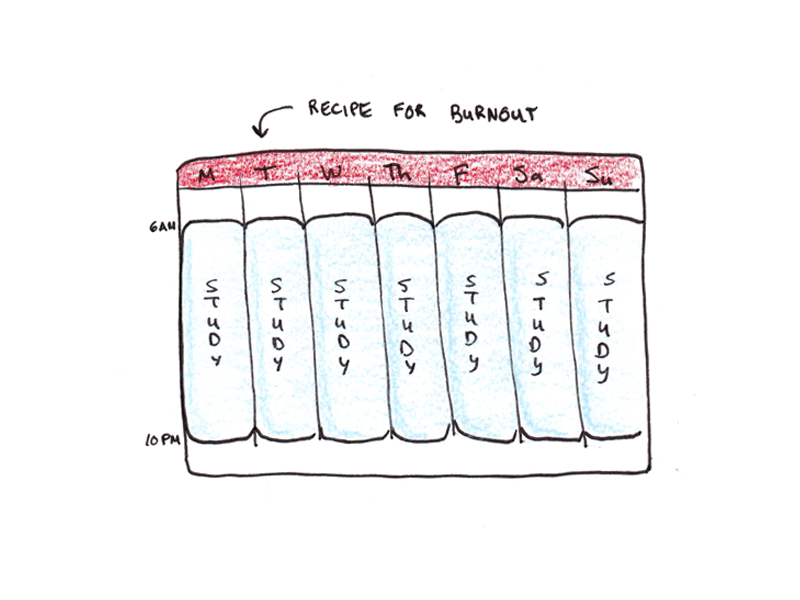
However, crafting this timetable comes with several common pitfalls that can easily derail even the most motivated learners. One major misstep is attempting to study for excessive lengths of time. Very few individuals possess the mental stamina to concentrate reliably for more than five to eight hours per day, even when fueled by exceptionally high levels of motivation. Studying schedules that demand twelve or more hours of intense focus daily are largely fantastical. The most likely outcome of such an aggressive plan is chronic procrastination and wasted time, rather than sustained, deep focus across the entire period.
Another frequent error is failing to incorporate vital human needs such as adequate sleep, physical exercise, socialization, and stress relief. When an individual is studying full-time for a monumental objective, the temptation to trim away other aspects of daily life to maximize study hours can be overwhelming. Certainly, when facing a highly competitive examination where passing is uncertain, maintaining a narrow focus is necessary. However, if the study period extends beyond a single week or two, cutting back on foundational health pillars often proves counterproductive.

Sleep is perhaps the most critical casualty in these scenarios. Because sleep plays an irreplaceable role in memory consolidation, a student who deliberately reduces their rest to six hours a night just to squeeze in an extra two hours of studying is actively undermining their own cognitive performance. Physical exercise functions similarly as a proven cognitive booster. Even a brief, fifteen-minute burst of higher-intensity activity is entirely sufficient for someone operating under a heavy workload. Furthermore, maintaining some baseline level of social contact and stress relief remains essential, particularly when educational endeavors span multiple months.
Ignoring the necessity of short breaks throughout the day represents another critical misstep. The exact volume of breaks required varies depending on the individual and the nature of the learning activity. For instance, intensive coursework often requires fewer breaks during direct lecture viewing than during heavy reading sessions, while complex problem-solving days demand the most frequent pauses. Inserting regular ten-to-fifteen-minute breaks helps preserve cognitive stamina. Learners are advised to monitor when fatigue begins to set in and focus starts to degrade, utilizing those windows for short walks or quick rest periods rather than turning to social media or digital entertainment, which should be saved for designated leisure time.
Finally, many learners fail to schedule larger chunks of uninterrupted time off during evenings or weekends. While personal preference plays a role, ensuring at least some free evening time and a dedicated day off each week tends to yield optimal long-term productivity. Pushing beyond these boundaries frequently results in diminishing returns and net-negative productivity. This constraint is naturally more flexible for individuals who balance studies with other mandatory obligations, such as a separate job or domestic chores, which may restrict learning exclusively to evenings and weekends. Ultimately, treating a full-time study period like an endurance event—where pacing and recovery are carefully optimized—provides a sustainable path toward long-term success.
Creating a Serious, Part-Time Studying Schedule
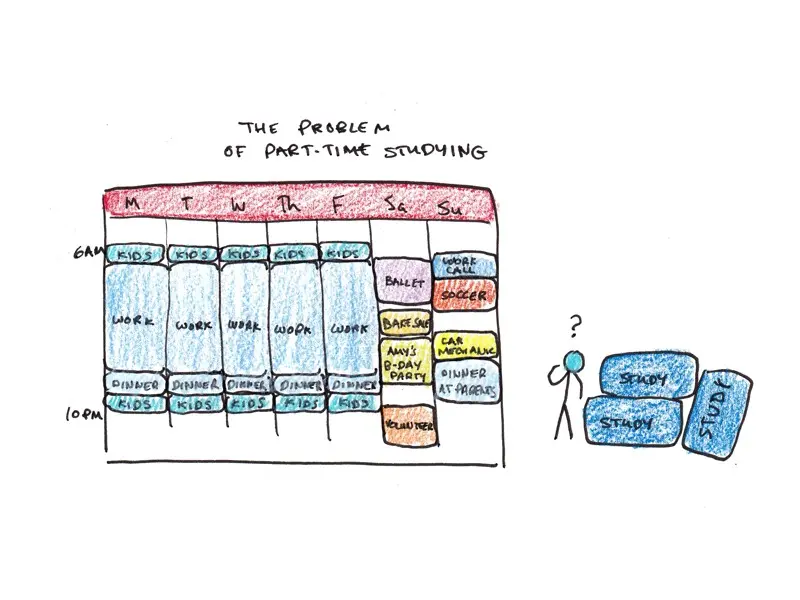
While full-time studying presents formidable challenges, pursuing education on a part-time basis is arguably even more difficult. Individuals who must master complex subjects while simultaneously managing the demanding responsibilities of a full-time career or childcare face immense strain, squeezed by higher pressure and fewer available hours. Successfully navigating this environment demands meticulous planning and rigorous preparation.
The initial step in this process involves mapping out all mandatory, non-negotiable commitments—such as working hours in an office or primary caregiving duties—when learning is simply impossible. These fixed blocks must be removed from the calendar first. Next, learners need to identify where the largest chunks of unscheduled time reside within their weekly routine, which for most people will be found in the early mornings, late evenings, or weekends.
Once these windows are identified, the next phase requires choosing a consistent studying routine that feels sustainable given the desired time investment. A learner might choose to wake up significantly earlier to study from six to nine in the morning before heading to work, opt to remain at an office workspace until evening, study right before bedtime, or dedicate one or two full weekend days to the project.
Regardless of which time slot is selected, maintaining a rigid, highly consistent routine is paramount. If an individual decides to carve out fifteen hours per week on top of a full-time job by studying for three hours every single morning, adhering strictly to those exact times makes the routine far more tolerable than attempting an ad-hoc timetable.
The same foundational health guidelines regarding sleep, exercise, and stress relief apply here, though they require more careful navigation. Because part-time learners lack the luxury of all-day studying, ensuring a sufficient accumulation of hours becomes the priority rather than fine-tuning the minute-by-minute efficiency of every single session. Consequently, while spreading twelve hours across a single day can be counterproductive for a full-time student, a part-time worker who has only three available hours will benefit immensely from reliably protecting and utilizing that specific block.
Ultimately, however, every part-time strategy is strictly constrained by sustainable personal capacity. For individuals juggling full-time employment, young children, and a myriad of other life responsibilities, a target of fifteen study hours per week may prove overly ambitious. In such instances, starting with a smaller, highly reliable time commitment—even if it initially feels insufficient for the ultimate goal—yields far better results than aiming unrealistically high and repeatedly falling short.
Recovering Spare Moments of Time
Beyond rigorous full-time and part-time commitments, many individuals find themselves drawn to learning goals that cannot realistically take precedence over their existing life priorities. When dedicating scheduled blocks of time is simply not feasible, learners often wonder how they can maximize their available time for casual or spontaneous education.
Generally speaking, structured and dedicated time blocks tend to outperform ad-hoc learning attempts, even when intrinsic motivation is exceptionally high. This psychological reality explains why formal, in-person classes often yield better completion rates than self-paced online courses. While the core instructional material may be identical, signing up for an in-person class forces the learner to show up at a specific time and place, effectively transforming an unstructured desire into a reliable commitment.
The primary difference between a serious part-time strategy and a spare-moment approach is not necessarily the total volume of time dedicated, but rather the requirement in the latter model to make spontaneous decisions to learn during opportune windows throughout the day. Because learning is an inherently effortful endeavor, engaging in activities such as reading a textbook, watching educational videos, or practicing a complex skill almost always feels like an uphill battle compared to low-effort alternatives like streaming television or playing video games. Consequently, even if a person could theoretically reclaim five to ten hours a week for a passion project, spontaneous motivation frequently falters, leading them to choose easier distractions instead.
This inherent friction is why establishing dedicated time habits remains the preferred path for most educators. Committing to a high-effort task is vastly easier when it is habitual rather than subject to repeated, spontaneous choices throughout the day. For those who must rely on spare moments, success depends on finding ways to lower the effort threshold required to begin learning. Reducing friction makes it easier to cross into productive engagement on a regular basis.
While some educational platforms attempt to solve this by watering down the material to make learning feel effortless—such as gamified language apps—these approaches often yield disappointing long-term results relative to the time invested. Such methods frequently isolate learners from more rigorous and effective instructional strategies.
Combining the Approaches
A fourth option involves adopting a hybrid model that bridges the gap between a fixed study schedule and spontaneous daily engagement. This approach is particularly effective for complex subjects that naturally encompass a mixture of high-focus activities and low-effort tasks.
Language acquisition serves as a prime example of this hybrid methodology in practice. A learner might maintain scheduled appointments for live conversation practice and dedicated textbook sessions to master intricate grammar rules, while simultaneously utilizing lower-effort activities—such as watching foreign-language television shows with dubbing or reviewing flashcard decks—at random, unstructured intervals throughout the day.
This combination can successfully extract additional learning time from an otherwise packed schedule, provided the learner accurately distinguishes between tasks that demand deep, uninterrupted focus and those that can be executed in brief, casual increments.
Ultimately, the study schedule that an individual successfully maintains will rarely match their initial blueprint. Unforeseen life interruptions, physical fatigue, and fluctuating motivation inevitably disrupt even the most meticulous plans. However, thoughtful preparation remains a powerful tool. For arduous educational projects, a well-structured schedule transforms a heavy burden into a manageable endeavor. For inspiring and enjoyable learning goals, a concrete plan shifts the process from passive daydreaming into active execution, vastly improving the likelihood of long-term success.