
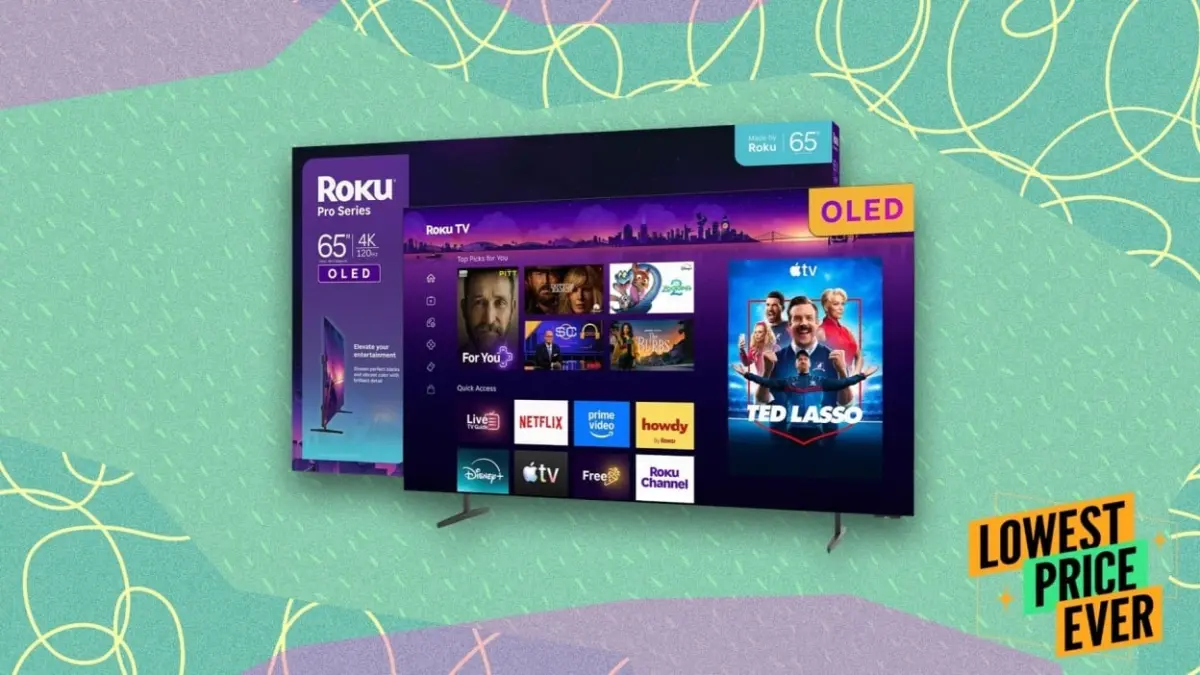
For buyers looking to break into the OLED market without paying top-tier prices for legacy brands, this deal presents a compelling entry point. At this price point, consumers receive a 4K OLED panel capable of delivering the characteristic deep blacks and infinite contrast ratios that make OLED technology a favorite among home theater enthusiasts. However, prospective buyers should take note of the panel’s peak brightness levels. Measuring at approximately 496 nits, the display is relatively dim compared to modern QLED or LED-backlit alternatives. This means that while it performs brilliantly in dark rooms or controlled home theater environments, brighter living spaces with ample sunlight or heavy ambient lighting may cause darker cinematic scenes to lose shadow detail.
Where the Roku Pro Series OLED truly distinguishes itself from the competition is in the realm of gaming performance. Equipped with a 120Hz refresh rate, variable refresh rate (VRR) support, and AMD FreeSync Premium compatibility, the television is engineered to keep fast-moving action sequences looking remarkably smooth and tear-free.
Testing from industry publications has highlighted these gaming strengths. A review by PCMag measured the television’s input lag at an exceptionally low 4.8 milliseconds when running at 1080p and 120Hz, and just 8.8 milliseconds at 4K and 60Hz. These figures earned the display the publication’s Lab Award for lowest input lag in its class. In practical terms, this translates to virtually imperceptible latency between pressing a controller button and seeing the corresponding action rendered on screen, a critical advantage for fast-paced genres such as competitive shooters and high-speed racing titles.

In addition to its impressive response times, the television accommodates modern gaming and entertainment setups with four dedicated HDMI ports. It also offers comprehensive high dynamic range support, including Dolby Vision, HDR10, HDR10+, and HLG. The only notable omission on the connectivity and performance front is support for Nvidia G-Sync, which may matter to certain PC gamers utilizing specific graphics cards, though the inclusion of standard VRR and AMD FreeSync covers the vast majority of console and PC use cases.
Beyond its gaming capabilities, the television functions as an entertainment hub driven by Roku’s proprietary operating system. The interface remains one of the platform’s core selling points, offering a straightforward, uncluttered layout that puts streaming applications directly front and center instead of burying the user beneath endless promotional recommendations or algorithmic suggestions.
The software ecosystem supports nearly every major streaming and subscription service currently available, with the notable exception of Twitch. For Apple device users, the integration of Apple AirPlay allows for seamless casting and content sharing from iPhones, iPads, and Mac computers directly to the big screen. Physical connectivity includes Wi-Fi 5 for wireless networking and a built-in ATSC 1.0 tuner for viewers who still utilize over-the-air digital broadcast antennas.
Certain modern conveniences have been omitted to hit this price point, most notably hands-free voice control. Users cannot simply speak commands into an empty room; instead, they must rely on the included physical remote control to activate voice search and commands. Even with these minor compromises, the combination of a 4K OLED panel, high-refresh-rate gaming features, and a record-breaking price cut makes Roku’s first OLED offering one of the most notable display deals currently available.