
The sender was a 77-year-old American woman who was set to board a flight to Zhangjiajie the very next morning. She was embarking on a 12-day journey, traveling completely on her own.
Two months prior, she had first initiated contact by sending a meticulously self-planned, day-by-day itinerary. Attached to it was a list of 26 specific requirements, accompanied by a request to confirm each point individually. One instruction stood out vividly: every cableway, lift, and escalator had to be included in the arrangements. Upon reading that specific demand, her guide realized that this traveler understood something about exploration that many people—regardless of age—never quite figure out.
Millions around the globe are familiar with the cinematic landscapes of the blockbuster movie Avatar. The soaring, mist-shrouded stone pillars depicted as the floating Hallelujah Mountains were modeled directly on the dramatic topography of Zhangjiajie in China’s Hunan province. Having grown up surrounded by these towering sandstone formations, the local guide began working in tourism in 2016. In recent years, a noticeable demographic shift has occurred. An increasing number of foreign visitors arriving in the region are over the age of 60.

Among these older travelers, female visitors frequently share a common concern. Nearly every woman in that age bracket sends an initial email asking a variation of the same apprehensive question: “I hear there are a lot of stairs. Can I manage at my age?”
While most ask which stairs they will have to endure, this particular 77-year-old traveler had approached the challenge differently. She had asked which stairs she could deliberately skip.
Tuesday Morning and the Ascent to Wulingyuan
At a quarter past nine on Tuesday morning, the guide met her at the airport. They drove directly to Wulingyuan, where accommodations had been secured right at the park gate rather than in the distant city center. For older visitors, lodging near the entrance is a primary logistical priority. Staying at the gate eliminates two lengthy vehicle transfers each day, allowing guests to sleep a little later in the morning and return comfortably earlier in the afternoon.
The classic, breathtaking view of the towering stone pillars is best observed from Yuanjiajie, situated high upon the upper plateau. While younger, more energetic visitors frequently choose to hike all the way up from the valley floor, this journey took a different route. They utilized the Bailong Elevator, a striking glass sightseeing lift built directly onto the exterior of a sheer vertical cliff face. The engineering marvel transports passengers from the valley floor to the summit in just over a minute. From the top of the elevator, the park’s eco-bus network carried them smoothly to the viewing platform.

Standing at the railing, the traveler paused to take in the sprawling vista before turning to her guide with a knowing smile. “So this is the Hallelujah Mountain from Avatar,” she remarked.
Having stood at that exact vantage point with numerous travelers in their 70s and 80s, the guide noted that the visual experience of the landscape remains entirely uncompromised by age. What an elderly visitor sees from the viewing platform is precisely what a 20-year-old traveler sees. The sole distinction lies in the mode of ascent—choosing a lift over a grueling vertical climb.
Managing the Pace After Three
Between the various scenic viewpoints, the pair relied on the park’s eco-bus system. From each designated bus stop to the main observation platforms, the walking paths are fully paved, establishing a natural rhythm of walking a manageable stretch, pausing to absorb the scenery, and walking again. They enjoyed lunch on the mountain, surrounded by the towering peaks. Shortly after three o’clock in the afternoon, the guide escorted her down the mountain via the Tianzi Mountain cableway, ensuring she was safely back at her hotel by four.
This strict adherence to descending by mid-afternoon is a strategic rule enforced by the guide rather than an official park regulation. Because the cableways and elevators operate without fixed closing times—adjusting their schedules dynamically based on daily visitor volume—relying on a final evening ride is an unnecessary risk. By prioritizing the descent earlier in the day, the itinerary accommodates the physical realities of older guests, a factor the guide considers more critical than any other.

The itinerary also strategically omitted certain strenuous sections. The Golden Whip Stream, for instance, offers a picturesque valley path stretching more than seven kilometers. However, walking the entire route demands considerable time and physical endurance. To accommodate older guests, the guide limits the excursion to the initial, most scenic stretch near the entrance—allowing visitors to appreciate the flowing water and flanking stone pillars—before turning back. Similarly, the subterranean wonders of Yellow Dragon Cave involve navigating a vast number of interior stairs. For this traveler, that attraction was seamlessly swapped for a leisurely boat ride on Baofeng Lake, offering an equivalent immersion in water and mountain scenery from the comfort of a seat. Reviewing her preferences, the traveler had specified that she was a vegetarian who preferred breakfast only, allowing the daily lunch logistics to proceed smoothly without redundant inquiries.
Preparing for Tianmen Mountain and the Grand Canyon
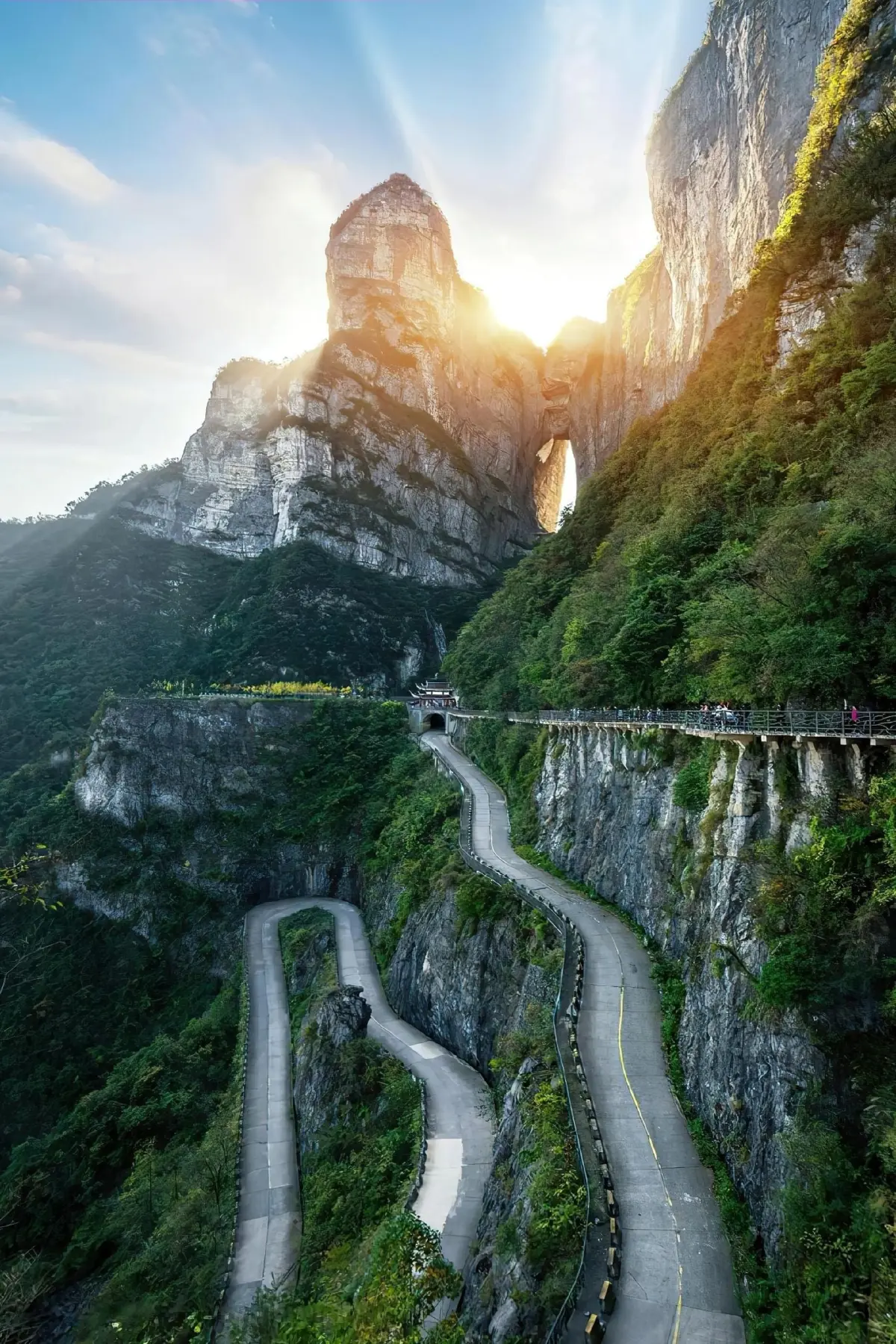
As the 12-day journey continued, the schedule turned toward Tianmen Mountain, famed for its colossal natural rock arch—known as Heaven’s Gate—embedded directly in the cliff face on the outskirts of the city. Outdated travel advice from older guidebooks often suggests taking a traditional cable car directly from the city center. However, that legacy cableway no longer transports passengers, making it essential to bypass obsolete routing instructions.
Modern access to Tianmen Mountain is streamlined: tickets are authenticated at the mountain gate, an express cableway transports visitors directly to the expansive square beneath Tianmen Cave, and a series of escalators engineered straight through the heart of the mountain carry travelers onward to the summit. The return journey follows the reverse path. For older travelers, this modern infrastructure is a distinct advantage, converting the entire mountain visit into a seamless sequence of cableway and escalator rides. The final push up to the massive cave features a dedicated five-stage escalator system, sparing visitors from confronting the daunting scale of the open-air staircase. Meanwhile, the renowned glass walkway clinging to the cliffside requires specialized protective shoe covers and remains entirely optional. Those who prefer to bypass the transparent pathway can simply relax in the square beneath the arch and watch the shifting mountain clouds.
Later days in the itinerary featured the famous Glass Bridge spanning the Grand Canyon. Tickets covering both the canyon and the bridge were secured in advance, with the decision to descend to the canyon floor left entirely dependent on how the traveler’s legs felt on the day of the visit. Choosing to remain on the upper level still allows travelers to cross the architectural marvel using the same admission. Because the canyon floor involves negotiating numerous steps, the guide deliberately avoids scheduling this excursion on the first day of the trip, preferring first to observe how a guest navigates standard, level ground.

Redefining Personal Boundaries
Reviewing the traveler’s initial message alongside her detailed 26-item checklist reveals a clear philosophy. She is neither averse to physical exertion nor seeking to shy away from genuine experiences. Instead, she has exercised deliberate agency over her journey, carefully discerning which stretches of terrain are rewarding to walk and which segments are best entrusted to mechanical lifts. Her solo journey across the globe at age 77 is not about proving an arbitrary ability to climb endless stairs.
Similar considerations guide operations for travelers with mobility impairments. Guides experienced in the region note transparently that the park’s level interior pathways, eco-buses, cableways, and the Bailong Elevator are fully accessible. However, the observation trails situated on the rugged mountain summits feature numerous steps, making wheelchair navigation in those specific zones exceptionally difficult. For wheelchair users, itineraries are deliberately tailored to maximize riding opportunities and scenic viewpoints accessible from transport hubs, without making unrealistic promises about traversing every remote footpaths.