
Settling into the new space with only a fraction of her usual belongings offered an immediate exercise in minimalism. Surrounded by minimal stock furniture and a vastly scaled-down inventory of personal items, Mia began observing how physical surroundings directly influence mental clutter and daily habits. The experience has yielded several unexpected insights into consumption, functional design, personal boundaries, and the relentless accumulation of domestic items.
1. Use It Up
One of the defining characteristics of staying in a furnished rental is the presence of hotel-sized portions of everyday essentials. Having brought her own toiletries and cleaning supplies from home, Mia initially viewed these miniature provisions as redundant extras. In the past, she admits, a deep-seated hoarding mentality would have compelled her to save the tiny items for some hypothetical future scenario where miniature toiletries might prove useful.
This time, however, she adopted a radically different approach: she simply used them up. Recognizing that these travel-sized items were often the least functional versions of everyday necessities, she realized that preserving them offered no real enrichment to her life. By consuming them first and discarding the empty containers immediately, she managed to clear physical and mental real estate, reinforcing her belief in the philosophy of "use-it-up" decluttering.
2. Functional Decor
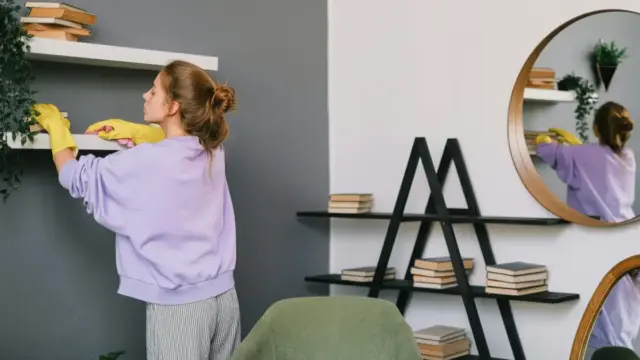
As a self-described homebody, adapting to an unfamiliar space away from her personal belongings presented a unique psychological challenge. To bridge the gap between an austere rental and a comforting home environment, she resisted the urge to hide her few personal items away in drawers. Instead, she displayed them prominently: draping a colorful throw blanket over the couch rather than folding it neatly away, and propping her books throughout the apartment rather than stacking them on a bedside table.
While such an approach in a densely populated home might quickly descend into visual clutter, working with a strictly limited number of mementos created a warm, inviting atmosphere. By allowing everyday items to serve a dual purpose—functioning practically while simultaneously acting as decor—she discovered a way to make the space feel genuinely lived-in without introducing useless accumulation.
3. This Spoon
A particularly poignant lesson in utility arrived around her birthday, when a visiting friend presented her with a small wooden spoon. Living with sensory processing issues, Mia experiences severe discomfort and nausea from the metallic clinking of standard silverware. To avoid using the metal utensils provided by the apartment complex, she had initially resorted to saving plastic cutlery from takeout meals during her first days in town.
The arrival of the wooden spoon completely changed her routine. Perfectly sized and deeply sentimental, the gift immediately replaced the need for standard flatware. Combined with a simple pair of chopsticks, the single utensil made the remainder of the apartment’s utensil drawer entirely obsolete. The experience reinforced the principle that owning a single item capable of serving its purpose perfectly—especially one that brings genuine joy—is infinitely preferable to maintaining a drawer full of mediocre alternatives.
4. Alone Time
Another striking shift in her temporary lifestyle has been the dramatic reduction of her social calendar. While she maintains contact with a few nearby acquaintances, her daily interactions pale in comparison to her bustling social life back home. Although initially viewing this isolation as a drawback given her affection for her friends, she quickly discovered the profound energizing effects of solitude.
Thriving on alone time despite a natural human tendency to seek constant connection, she found that her simplified schedule and easy-to-maintain living space unlocked an unprecedented level of daily ease. Mornings now begin with effortless, routine walks to the gym for workouts. Her apartment remains consistently spotless, and she has found ample time to prepare healthy, home-cooked meals.
Furthermore, the newfound mental space and freed-up schedule allowed her to get significantly ahead on professional obligations, including the management of a business she acquired a few months prior. While she intends to gradually reintegrate social activities—such as game nights with old friends and a return to physical training—she acknowledges that prolonged solitude has proven remarkably productive and revitalizing.
5. Clutter Comes Fast
Despite the intentional minimalism of her temporary setup, the experiment highlighted how rapidly domestic clutter accumulates. Following her recent birthday celebrations, new gifts quickly began occupying physical space in the apartment—noted humorously by the presence of a small trampoline resting beside her workspace. Similarly, a single kitchen cabinet filled up within weeks with saved plastic food containers.
Observing this progression underscored a fundamental reality of domestic life: the natural flow of consumer goods within a household is almost exclusively inward. Without intentional, continuous efforts to filter items back out, belongings inevitably pile up over time. To combat this, Mia quickly reinstated her regular passive decluttering strategies, demonstrating the importance of staying proactive before accumulation becomes an unmanageable burden.
Evaluating the Experiment
When asked whether the relocation experiment has achieved its primary objective, Mia reports encouraging results. The dramatic physical change appears to be helping her health, marking the first tangible improvement she has experienced in years.
While the realization that her permanent home environment may be the source of her long-term health complications brings a complex mix of emotions, the additional mental clarity gained during her time away provides a solid foundation for addressing the challenge moving forward. As she continues her three-month residency, she plans to maintain her streamlined routines and prepare for upcoming community initiatives, including the scheduled Holiday Decluttering Challenge.