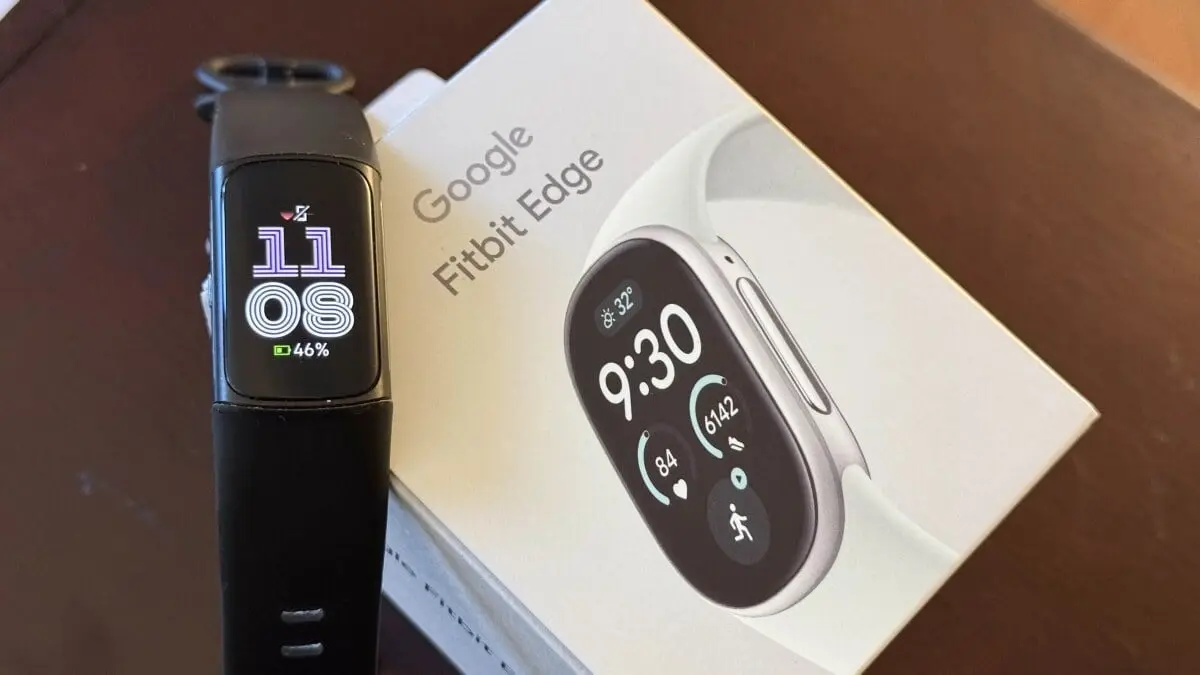
Examining the two devices reveals several distinct shifts in philosophy, hardware choices, and everyday functionality. From design ergonomics to internal tracking components and smart features, Google has made a series of calculated adjustments. By looking closely at what has been added, refined, or outright removed since the generation of the Charge 6, buyers can better understand where the new Fitbit Edge fits into the broader ecosystem of wearable technology.
The Fitbit Edge Introduces a Real Side Button
The most immediate and striking difference between the devices lies in their physical construction and interface design. The Fitbit Edge occupies a specific design sweet spot, positioning itself neatly between the screenless Fitbit Air and the smooth, curved glass display of the Pixel Watch. Operating on the same underlying software platform as the Fitbit Air—which diverges slightly from the operating system powering the Pixel Watch series—the Edge maintains broad compatibility by pairing seamlessly with both iOS devices and Android smartphones.
Upon unboxing a review unit provided by Google, one physical change becomes immediately apparent: the inclusion of a genuine, tactile side button located on the right casing of the device. Pressing this button yields a satisfying, audible click, functioning reliably even when the hardware is completely powered down. This is a notable departure from the design of the Charge 6, which relied on a capacitive, haptic "button" rather than a moving mechanical part. On the older model, users often had to squeeze the casing and hope the device recognized the input, frequently resulting in inconsistent feedback or delayed haptic responses. The return of a true physical button addresses a longstanding user critique regarding reliability during workouts when fingers might be sweaty or cold.
The Fitbit Edge Features an Altimeter and Upgraded GPS Hardware
Beyond interface mechanics, the internal sensor suite has also undergone notable modifications. Most prominently, the Fitbit Edge introduces a dedicated altimeter, a piece of hardware that has been absent from Fitbit trackers since the release of the Charge 4. This atmospheric sensor enables the device to measure changes in elevation, translating directly into metrics tracking the number of floors climbed throughout a standard day. Furthermore, the inclusion of an altimeter allows for much more precise tracking of elevation gains, inclines, and descents during outdoor activities such as trail hiking and hilly running sessions.
Both the Charge 6 and the newer Edge are equipped with independent GPS capabilities, meaning users can accurately map outdoor routes, track pace, and record distances even if they leave their smartphones behind at home. This stands in contrast to the screenless Fitbit Air, which lacks its own GPS hardware and must continuously rely on a connected phone for location data. However, the GPS implementation on the Charge 6 drew criticism due to hardware limitations; specifically, wearing the wristband too tightly could strain the internal GPS antenna, leading to distorted, inaccurate route mapping during workouts. Google has asserted that the Fitbit Edge incorporates a vastly improved GPS chipset designed to resolve these tracking anomalies and deliver more reliable geographic data.
The Fitbit Edge Omits Google Pay and NFC Capabilities
Despite the hardware upgrades found in other areas, the transition to the Fitbit Edge also involves a significant functional subtraction. Most notably, the new tracker completely lacks Google Pay and near-field communication (NFC) capabilities.
On the previous Charge 6, users could easily configure Google Wallet to make contactless payments directly from their wrists simply by tapping the device at participating retail terminals. This functionality proved particularly popular among runners, walkers, and cyclists who preferred to exercise without carrying wallets or phones while retaining the ability to purchase refreshments along their routes. The omission of NFC hardware on the Fitbit Edge appears to be a deliberate compromise, likely necessary to accommodate other internal components within the compact chassis. Consequently, consumers who relied heavily on contactless wrist payments with their older wearables will find this feature absent if they choose to upgrade.
Universal Music Control Replaces App-Specific Limitations
One of the most frequent complaints directed at the Fitbit Charge 6 centered on its restrictive music playback controls. On the older model, the music interface was deliberately tethered exclusively to YouTube Music. Because YouTube Music is a premium subscription service, users were required to maintain an active monthly paid subscription simply to manage audio playback on their paired smartphones. Furthermore, individuals subscribed to alternative platforms such as Spotify or Apple Music were left entirely unsupported by the native controls.
Google has directly addressed this limitation with the Fitbit Edge. According to official specifications, the new tracker is designed to act as a universal controller capable of managing whatever audio source is currently active on the user’s phone. By moving away from a single proprietary ecosystem, the Edge aligns itself with the broader standard of modern smartwatches, offering greater flexibility and convenience for individuals who utilize various streaming services.
Google Maps Integration Is Slated as a Post-Launch Feature
As consumers evaluate the initial software capabilities of the Fitbit Edge at launch, one notable omission is the temporary absence of native Google Maps directions. While the out-of-the-box software does not support turn-by-turn navigation directly on the wrist, official Google documentation indicates that the feature is actively in development and "coming soon" via a future software update.
For many users, this transitional gap may not prove disruptive. On previous iterations like the Charge 6, Google Maps integration functioned within a somewhat isolated interface that provided basic text prompts rather than a comprehensive, interactive map view displaying the user’s immediate surroundings. Nevertheless, individuals who routinely relied on wrist-based navigation prompts will need to exercise patience while awaiting the promised software rollout for the Edge. As Google prepares to distribute the device to consumers who have secured early pre-orders, the fitness community continues to evaluate how these hardware and software adjustments will translate into real-world daily performance.