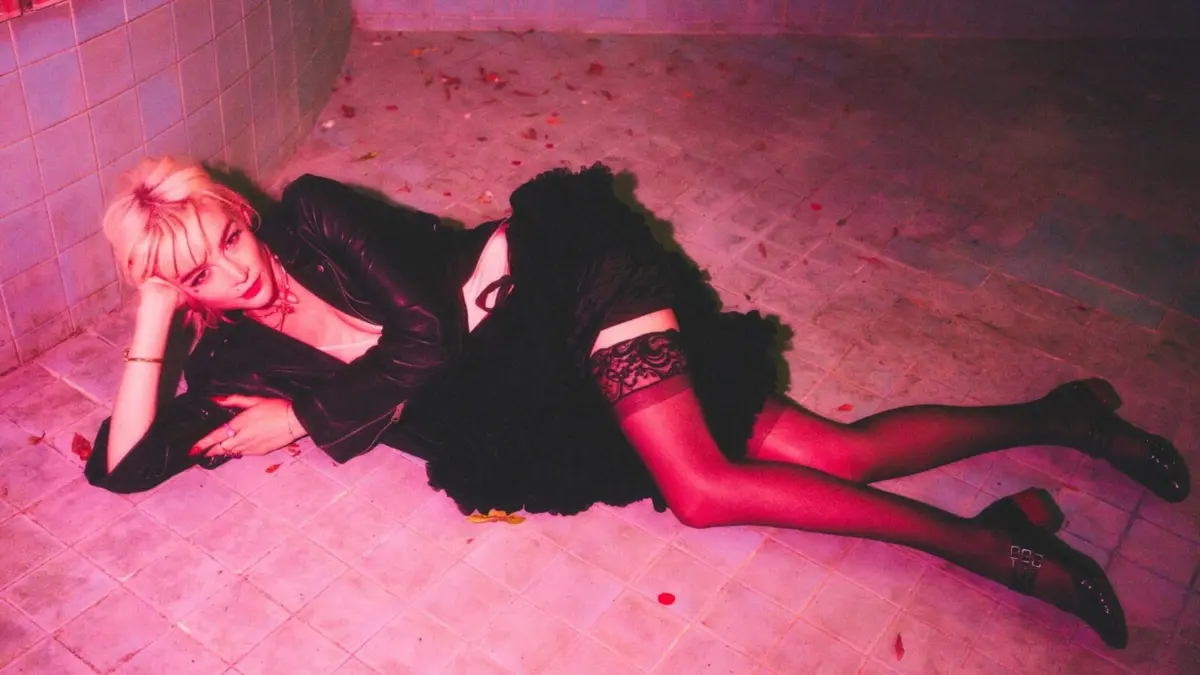

In an era defined by endless digital notifications and algorithmic feeds, the home functions as what Teilz half-jokingly calls a “’90s-electronics household.” Entertainment here is tactile, intentional, and unmistakably retro. There is a video projector, a working turntable, and an expansive wall lined with VHS tapes sourced from local thrift stores and estate sales. Animated classics like Yellow Submarine and The Land Before Time remain in heavy, affectionate rotation.

This environment reflects the sensibilities of a creator who has spent decades immersed in music culture. As a vinyl DJ and producer, Teilz forged her reputation across the competitive Los Angeles nightlife circuit, having shared booths and stages with icons such as Grace Jones and Daft Punk. Yet today, navigating life as a mother of four, she approaches her creative craft and domestic responsibilities not as conflicting forces, but as an integrated existence. Describing herself straightforwardly as “a mother first and an artist second,” she demonstrates how an artist can fully embrace the demands of parenting without abandoning the essence of who they were before having children.

Her debut full-length album, Come to Mommy, serves as an auditory reclamation of that internal creative fire. Atmospherically layered, electronic, and intensely dance-driven, the project bridges nostalgic retro-electronic textures with contemporary soundscapes. Even its title carries deliberate subversive weight. By flipping the patriarchal idiom “come to daddy” on its head, Teilz pivots away from external expectations to interrogate what maternal pleasure actually looks like. While wider society often fixates on patriarchal desires, Teilz chooses instead to ask what a mother desires. Her answer is immediate and unapologetic: joy, celebration, uninhibited dancing, and an enduring claim to personal pleasure.

We can let motherhood deepen the art
Rather than viewing parenthood as an operational obstacle around which creative work must be delicately arranged, Teilz frames her children as the primary catalysts behind the deepening of her art. In her experience, the transition into parenthood did not diminish her creative capacity; rather, she emphasizes that becoming their mother made everything bigger, not smaller.

Part of this creative evolution stems from the pragmatic realities of modern parenting. With hours fractured by the continuous care of four children, the luxury of aimless creative wandering disappears. For Teilz, however, that temporal scarcity became an unexpected creative asset. Motherhood demonstrated that profound artistic clarity can emerge precisely when time is strictly limited, forcing an artist to strip away superfluous noise and focus entirely on what truly matters.

Beyond time management, she describes an existential surrender intrinsic to bringing new life into the world. Handing oneself over to guide developing human beings through life cracked open her creative process rather than shutting it down. She explains that this profound shift liberated her during the creative process, offering a vastly deeper emotional well from which to draw inspiration. It has led her to view the journey of raising children as the highest and most transformative form of art she has ever encountered.

This expanded perspective fundamentally altered the types of work she feels called to create. Looking at the cultural landscape through her children’s eyes, Teilz measures her output against a clear standard: what kind of work does she genuinely want to introduce into the modern world? In her view, that vision stands in direct opposition to the mechanized homogeneity she characterizes as “AI art and lobotomy chic”—a term she uses to describe the soulless, automated media that has increasingly saturated modern culture.

Instead, she aims to offer her children the same transformative creative awakenings she experienced during her own formative years. She recalls the electric freedom of discovering Talking Heads for the first time, an experience that granted permission to move wildly, embrace eccentricity, and imagine oneself dancing inside an oversized David Byrne suit. Her goal is to protect and prolong that open state of play. Come to Mommy serves as her tangible contribution to reintroducing that spirit into the world, an endeavor she attributes directly to the perspective provided by her household. In her words, her children remain her greatest teachers.

We don’t have to choose a singular version of ourselves
For many women, the transition into motherhood is accompanied by a subtle, systemic pressure to minimize the self. It is a well-documented trajectory wherein personal ambitions, desires, and identity markers are steadily compromised to accommodate the needs of the family unit. Teilz readily admits to having felt that gravitational pull in the early years of parenting, noticing how easy it was to slip into the patterns of self-erasure she observed in the culture around her.

She witnessed it frequently in contemporary parenting culture: maternal support spaces where participants consistently depleted themselves without taking their own basic psychological or creative requirements into account; professional trajectories paused indefinitely and never resumed; and an pervasive inability among mothers to clearly answer who they were outside their parental titles.

Teilz traces much of this conditioning to classic cultural texts passed down through generations. She specifically identifies widely read children’s fables like The Giving Tree and The Rainbow Fish as insidious mechanisms of socialization that frame complete self-obliteration as the ultimate expression of love. The narratives carry an implicit, damaging premise: reduce oneself to a lifeless tree stump to prove devotion, or strip away one’s personal sparkle to secure social acceptance. Teilz cautions that celebrating self-annihilation as moral righteousness is an inherently dangerous narrative for caregivers to absorb.

Reversing that drift required active, structural intervention in her daily routine. The solution, she found, lay in establishing unapologetic boundaries. In practical terms, this includes utilizing an analog flip phone during specific hours of the day when she chooses to be entirely unreachable by the digital ecosystem. She often cites an axiom encountered online that crystallized her resolve: establish firm boundaries or eventually develop an autoimmune disorder.

For Teilz, declining physical well-being served as the definitive warning sign that she could no longer neglect her own needs. Protecting her health required a conscious refusal to disappear into domesticity. Ultimately, she concluded that children do not benefit from a mother who dissolves completely into her roles, noting that a parent who vanishes into motherhood ceases to model the wholeness and agency her children need to witness.

We get to decide what their childhood feels like
Rather than relying on generic modern conveniences or consumerist milestones, Teilz approaches the curation of her family’s daily life much like the production of a vinyl record—assembling it through specific, deliberate, and imaginative textures. When her daughter was recently recognized with a leadership award at school and granted the freedom to design her own celebration, she chose to create stacked “ice cream mountains.” Arranging scoops into elaborate castle formations across sheets of parchment paper, the activity drew inspiration directly from an ice cream parlor Teilz frequented during her own youth.

The impulse prioritizes playful whimsy for its own sake. When Teilz reflects on the most meaningful memories of her upbringing, they are rarely tied to lavish vacations or commercialized excursions. Instead, her mind returns to the modest one-bedroom apartment of her childhood and the quiet tradition of her mother allowing the children to select a special ice cream flavor before the first day of the school year. Drawing on those memories, she focuses her energy on crafting resonant, grounded moments for her own family.

Cultivating everyday wonder is central to that objective. Her children are frequently dispatched into the home garden to harvest fresh parsley or ripe tomatoes, ensuring their hands are physically connected to the preparation of their evening meals. Teaching them the complete cycle of cultivation—watching a tiny seed sprout, take root, and eventually yield an artichoke—provides tangible encounters with the small miracles of the natural world.

Literature occupies a similarly revered space in the home. Teilz recalls a striking scene that stayed with her years before having children of her own: watching a woman seated on a noisy, crowded subway car, quietly reading alongside her young daughter while the transit system churned around them. That quiet communion in public transit left a lasting mark. Today, watching her own daughter curl up on the living room couch to lose herself in the pages of Harry Potter represents one of her proudest milestones as a parent. Her message to other caregivers facing creative exhaustion is simple: remain curious about the wider world, keep reading, and stay fiercely invested in personal intellectual and artistic passions.

The road to synthesizing these facets of life was paved with severe hardship. The writing and recording of Come to Mommy took place during an intensely challenging period marked by a traumatic childbirth that nearly claimed the lives of both Teilz and one of her infant sons. The project inevitably reflects the process of navigating that crisis and finding a path forward.

The album’s concluding composition, titled “Back From the Dead,” was written directly for the twin she came close to losing. The track functions as an artistic declaration to all four of her children that recovery is possible, even after confronting devastating circumstances. Translating acute physical and psychological trauma into music became an essential vehicle for emotional processing. For Teilz, the finished body of work stands as tangible evidence to her household that severe hardship can be confronted, weathered, and ultimately transformed into something enduring and beautiful.

When contemplating the ultimate impact of her music on other parents, Teilz envisions a solitary, familiar scenario: a mother parked in the driveway at the end of a long day, letting the engine run a few moments longer to finish listening to the record before stepping through the front door. Teilz hopes that listener takes that moment to reclaim the uninhibited fire of her own inner life—remembering the exact song that inspired wild abandon at an adolescent birthday party, feeling deeply supported, and discovering an immediate reason to dance. Above all, she hopes the listener walks back into her home feeling entirely like herself.

In a cultural landscape that often suggests maternal devotion requires shrinking the boundaries of personal identity, Allie Teilz uses Come to Mommy to offer a continuous, rhythm-driven rebuttal.