
To the untrained eye, curling can easily be mistaken for a leisurely pastime. Lacking the immediate adrenaline rush of alpine racing or the gravity-defying flips of figure skating, the sport is frequently the butt of lighthearted jokes, with critics comparing its frantic ice-sweeping to aggressive household chores. However, those who dismiss the discipline fail to appreciate the profound technical skill, physical endurance, and tactical brilliance required to compete at the Olympic level. With historical roots tracing back to the 16th century, curling stands proudly as one of the oldest team sports in the world. When spectators begin to understand the complex geometry of the ice, the physics of the sliding granite, and the high-decibel tactical commands echoing across the sheets, it becomes readily apparent why the competition can be just as suspenseful and electrifying as any mainstream event.
What is curling and when did it become an Olympic sport?
At its core, curling is an intricate team sport conducted entirely on a sheet of specially prepared ice. Competition takes place either in single-gender teams consisting of four players each or in mixed-doubles formats featuring two-person squads. Athletes step onto the ice equipped with specialized footwear featuring dual-soled designs—one sole engineered to glide effortlessly across the frozen surface, while the other provides firm grip for stability—alongside customized sweeping brushes.
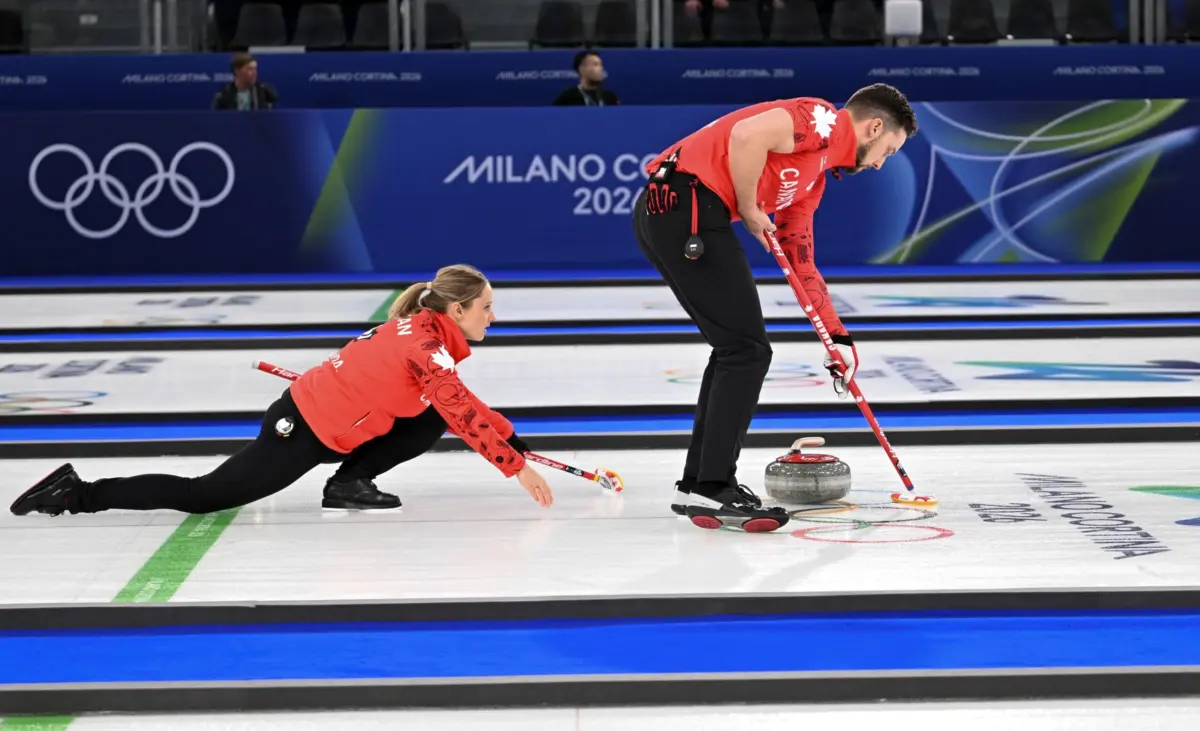
The primary objective of the game is deceptively simple in concept yet extraordinarily difficult in execution: players must slide 44-pound polished granite stones down the length of the sheet toward a concentric target known as the house, located at the opposite end. Once a stone has been released by a player, teammates are permitted to actively sweep the ice directly in front of the moving rock. This sweeping action serves a dual purpose. First, it clears away microscopic debris and frost that could otherwise impede the stone’s progress or alter its intended trajectory. Second, the friction generated by the sweeping slightly melts the top layer of the ice sheet, creating a thin film of water that allows the stone to travel farther and maintain its momentum.
According to historical records from the Smithsonian, the sport derives its distinctive name from the unique rotational movement—or curl—that the granite stone exhibits as it decelerates and curves toward the center of the house at the conclusion of its path.
Curling has a surprisingly rich and intermittent Olympic history. The sport made its official debut at the inaugural Winter Olympic Games held in Chamonix, France, in 1924. Despite its early introduction, curling vanished from the official Olympic program for decades, finally returning as a medal event at the 1998 Winter Olympics in Nagano, Japan. The 1998 Games also marked the historic Olympic debut of women’s curling. Continuing its evolution to meet modern athletic demands, the International Olympic Committee later introduced mixed-doubles curling to the official program at the 2018 Winter Olympics in PyeongChang, South Korea, steadily expanding the sport’s global footprint and popularity.
How do you win at curling?
Standard four-person curling matches are typically structured over the course of 10 distinct ends, which function similarly to innings or rounds in other sports. During each end, competing teams take turns delivering a total of 16 stones—eight per team. The players execute their deliveries in a strict, alternating rotation dictated by their designated positions. The lead throws the first two stones for their team, followed by the second player throwing the next two, the third player delivering the fifth and sixth stones, and finally the skip, who acts as the team captain and delivers the final two decisive rocks of the round.
Scoring in curling is governed by precise mathematical and spatial rules overseen by the World Curling Federation. At the conclusion of an end—once all 16 stones have been thrown—points are awarded based on the final positions of the granite rocks relative to the house. A team is awarded one point for every stone that is located inside or touching the outer rings of the house, provided that these stones are closer to the exact center target than any opposing team’s stone. If neither team manages to position a stone within or touching the house by the end of the round, no points are awarded, resulting in a blank end.
A massive element of the strategy and suspense that captivates curling enthusiasts involves meticulous shot selection. Teams must constantly adapt their tactical approach based on the evolving layout of the stones in the house. A standard draw shot is designed to slide gracefully into the house or rest directly in front of it to establish early scoring position. Conversely, teams may opt to throw a guard shot to deliberately shield their scoring stones from opposing attempts, execute a raise to bump one of their own stones into a more advantageous position, or unleash a high-velocity takeout to violently knock an opponent’s scoring stone entirely out of play.
The final shot of any given end is known as the hammer, and possessing the hammer confers a monumental competitive advantage. The team holding the hammer delivers the very last stone of the round, allowing them to dictate the final scoring outcome and frequently pursue multi-point ends. A coin toss typically determines which team delivers the first stone of the opening end, but for all subsequent ends, the team that failed to score in the preceding round is awarded the hammer. Because of this profound strategic advantage, teams will occasionally orchestrate plays to intentionally surrender a point during an end simply to secure the coveted hammer for the next round, highlighting the deep psychological chess match underpinning the physical competition.

When all scheduled ends have been successfully completed, the team that has accumulated the highest total number of points is declared the winner.
What’s behind the curling cheating accusations?
Curling has long cultivated a reputation as one of the most polite, harmonious, and self-policing sports within the Olympic movement. Players routinely congratulate exceptional opponent shots and traditionally police their own minor infractions without requiring intervention from umpires. This long-standing cultural norm is precisely why the controversy erupting at the Milano Cortina Games has sent shockwaves through the international curling community.
The focal point of the current Olympic competition centers on a series of explosive cheating allegations directed at both the men’s and women’s national curling teams representing Canada. During a fiercely contested men’s round-robin match between traditional powerhouses Canada and Sweden, Swedish players lodged formal complaints accusing veteran Canadian curler Marc Kennedy of illegally touching a granite stone after it had already been released from his hand. Under strict international curling regulations, any physical contact with the stone past the hog line—the designated line where release must be completed—is strictly prohibited, as even the most minute, microscopic touch can dramatically alter the trajectory, rotation, and speed of a 44-pound rock traveling down the sheet.
While on-ice officials did not immediately assess a rule violation during live play, high-definition video clips rapidly circulated across social media platforms, appearing to show Kennedy’s finger brushing against the granite rock post-release. The incident ignited a visibly tense on-ice exchange between the competing squads and immediately transformed into a viral news story dominating Olympic coverage. Kennedy has publicly denied any intentional wrongdoing, maintaining that his actions did not violate the spirit or letter of the rules, but the fallout has cast a harsh spotlight on the enforcement of delivery regulations.
The controversy deepened on the exact same day during the women’s tournament, when another high-profile Canadian curler, Rachel Homan, found herself on the receiving end of a strict officiating decision. An umpire intervened and officially removed one of Homan’s stones from play after suspecting a nearly identical post-release contact violation. Homan and her teammates vehemently disagreed with the umpire’s ruling, igniting a broader, contentious debate among athletes, coaches, and officials regarding how strictly release rules should be monitored and whether technological aids or video review should be formally integrated into future international competitions.
What is wheelchair curling?
Parallel to the traditional events, wheelchair curling remains a marquee discipline on the Paralympic calendar, maintaining the core strategic essence of the sport while introducing practical adaptations to accommodate athletes with physical impairments. The physical specifications of the ice sheet and the concentric dimensions of the target house remain identical to those used in the able-bodied tournaments. However, wheelchair curling athletes utilize a specialized delivery stick, allowing them to securely attach to the handle and propel the 44-pound granite stones smoothly from a seated position.
Crucially, wheelchair curling does not feature the sweeping element that characterizes traditional matches. Because athletes do not sweep the ice to alter the speed or path of the stones, the initial delivery and tactical placement of the rocks carry even greater importance. Governed by the International Paralympic Committee, the sport is contested exclusively in mixed-gender teams comprising four athletes per side, providing a fiercely competitive and highly strategic showcase for athletes with lower-limb impairments. Wheelchair curling was officially integrated into the Paralympic program at the 2006 Winter Games in Turin, Italy, and has since grown into one of the most popular and respected events of the Winter Paralympics.
What is with the yelling in curling?
Viewers tuning into curling matches for the first time are invariably struck by the intense, vocal outbursts emanating from the athletes on the ice. Skips can frequently be seen and heard shouting explosive commands across the length of the sheet to direct their teammates. Because of this distinct auditory environment, curling has historically earned the affectionate moniker of "the roaring game."
The ambient noise levels inside modern Olympic curling rinks are remarkably high, driven by crowd noise, broadcast equipment, and the sliding friction of the stones. Consequently, skips must project their voices at maximum volume to ensure their tactical instructions are heard clearly by the sweeping team positioned yards away. A lexicon of specific commands has developed over centuries of play. Popular and frequently heard yells include sharp commands like "Woah! Woah!" to instruct sweepers to immediately cease brushing, "Hard!" to demand maximum sweeping exertion, "Right to it" to direct sweepers to bias their efforts toward the right side of the stone’s path, and "Yup" to signal continuous, controlled sweeping.
Despite the urgency and volume of these tactical communications, strict regulations enforced by governing bodies such as USA Curling explicitly prohibit foul, abusive, or offensive language on the ice, ensuring that the roaring atmosphere remains strictly within the bounds of athletic sportsmanship.
What are the standings for Team USA in curling?
As the Milano Cortina Games progress, the United States has already tasted success on the Olympic podium, securing a prestigious silver medal in the mixed-doubles curling tournament. Meanwhile, the American men’s and women’s four-person national teams remain deeply entrenched in round-robin group play, battling through grueling schedules to secure coveted spots in the upcoming playoff rounds as the tournament heads toward its dramatic conclusion.