
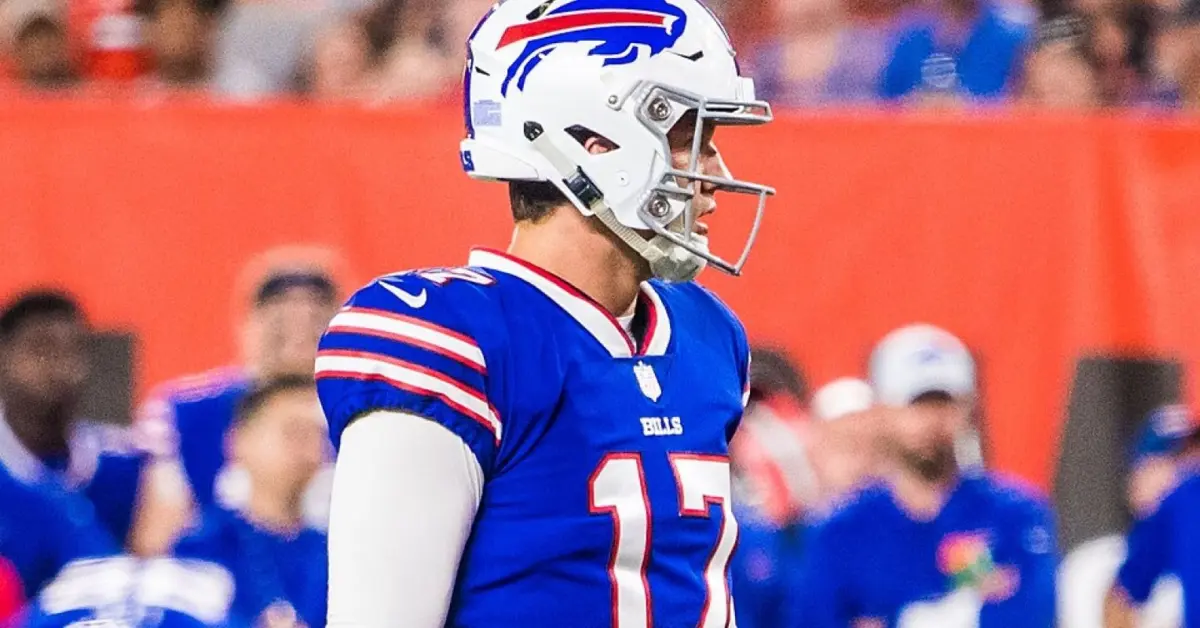
Yet, outside of those solemn occasions, it seems like just about everywhere else—at local sports bars, in grocery store aisles, walking through neighborhood streets, and even at the office on casual Fridays—fans are visibly honoring Buffalo Bills quarterback Josh Allen. Admirers celebrate his stellar performances, joining his growing fame and, with one unified voice, cheering on his and the team’s prospects for the season. That devotion is broadcast clearly on pullovers, hoodies, t-shirts, and coffee mugs.
As the autumn football season progresses, it is evident that "we" are winning, and often winning spectacularly.
"We"
That pronoun is used here advisedly, carrying a specific psychological weight. Fifty years ago, a young psychologist named Robert B. Cialdini and his academic colleagues noticed a fascinating phenomenon while conducting field experiments into sports fans’ emotions and social behaviors.
The researchers discovered that people naturally and personally associate themselves with a sports team’s success, even though they have no direct, physical role in producing it. While a loud home-field advantage can arguably influence a game as the stadium crowd drowns out an opposing quarterback’s calls, no spectator sitting in the stands actually gets to throw a touchdown pass, and nobody in the stadium will leap for that game-changing interception. Similarly, television viewers watching from home cannot realistically expect that their team will hear their gleeful shouts and favorable murmurs through the screen.
Still, devoted supporters proudly and personally bask in the warm glow of their team’s victories.
When loyalty is rewarded on the field, Monday mornings after a hometown victory are noticeably bouncier. Fans ask each other whether "we" looked good on offense, or note how "our" defense flawlessly coordinated the blitz and the coverage. They talk about how "we" stayed tough on critical third-down plays. After Cialdini documented this behavioral tendency, sports psychologists coined a specific acronym for the enthusiasm: BIRG-ing, which stands for the act of "basking in reflective glory."
Basking in reflective glory functions much like getting a physical suntan. The task might seem active and even purposeful on the surface, but the individual is really just resting, soaking in the ambient light of the team proclaiming that "we’re number one."
Testing BIRG-ing
A half-century ago, the team of psychologists set out to rigorously test and demonstrate the BIRG-ing phenomenon through three distinct field observations. The first examined how often university students wore apparel that clearly identified their school by name. Understandably, when their campus sports teams were winning, school sweatshirts appeared much more frequently on the student body than when teams were losing—particularly on Mondays immediately following a weekend game. That much remained unsurprising and plain to observe in everyday campus life.
The second and third field trials, however, yielded subtler and far more revealing results. The researchers noted that students whose teams had been victorious tended to personalize the institution and identify with it more strongly, frequently using the first-person plural pronoun. When students said "we" referring to their victorious team, the researchers concluded, they were actively proclaiming a desire to enhance their own public image as a direct reflection of the team’s success. When they said "we," they literally meant "they," but they spoke as if they themselves had managed the athletic victory on the field.
That kind of basking, the communal sharing of and taking credit for athletic achievements, carries an inherent irony. No matter how much viewers strain sympathetically and positively from the safety of a living room couch or a reclining chair, professional athletes are the ones executing grueling plays down on the field.
Yet a simple psychological affiliation, the researchers concluded, proved to be sufficient impetus for fans to trumpet success and publish their swelling pride—pride that can occasionally edge over into outright gloating. Consequently, society sees clear proof of this sentiment on fans’ buttons, bumper stickers, yard signs, and lawn displays that light up the night.
The "Good" in Good Feelings
It is easy to list the tangible social dividends of these shared positive feelings. Common admiration draws a community together in a spirit of collective devotion. At a time when external forces often work to divide and isolate populations, a sports franchise stakes out a non-partisan circle of spirit that gathers people together and bolsters their communal resilience.
Families, too, even when scattered across the country, will tune into the big game back home and share live commentary during halftime. The core spirit of athletic competition—the innate drive to excel in a high-stakes environment—provides enduring object lessons in resilience, physical strength, and stubborn persistence.
Fans in towns facing harsh winters can weather a tough loss on the gridiron or a crippling lake-effect whiteout with equal determination. When local fans shout encouragement on game day, they often mean far more than the score; they mean that they are hanging in there together.
Togetherness
Sociologist and play theorist Thomas Henricks describes this feeling of equalizing togetherness by using the sociological term communitas. Finding a common commitment and a central shared passion, Henricks argues, is one vital way that individuals discover their own identities.
Losing oneself temporarily in the collective experience of the game, a process of de-individualization, helps people figure out where they truly belong. In the context of organized sport, this feeling of communitas is typically temporary and event-driven, yet it avoids becoming entirely ephemeral because it recurs predictably whenever celebrants gather. The crowds return to the stadium, and the local fan clubs convene once more. Finding where they belong consistently puts supporters in a generous and welcoming mood.
When "We" Becomes "They"
Some loyal fan bases maintain extraordinary levels of generosity and patience through thick and thin. Win or lose, game after game, the Cleveland Browns famously packed their stadium end zone with body-painted followers who proudly called themselves the Dog Pound. Similarly, carrying the painful memory of four consecutive unsuccessful Super Bowl appearances, the Buffalo Bills retained the unwavering loyalty of their steadfast supporters despite failing to reach the postseason for 17 successive seasons.
Elsewhere in professional sports markets, however, sub-500 seasons promptly result in sparsely attended games and vanishing television audiences.
Sports psychologists have formally labeled the behavioral phenomenon that is the exact opposite of BIRG-ing. They call it CORF-ing, which stands for "cutting off reflective failure." Former or fair-weather fans will actively distance themselves from a struggling or losing team so as not to be put in a negative public light.
When a team enters a slump, the yard signs quietly come down, the team jersey goes back into the back of the dresser, and team-themed buttons end up relegated to junk drawers alongside unlabeled keys and expired coupons.
Tellingly, disgruntled fans noticeably alter their pronoun choices when their team suffers through a prolonged athletic drought. The familiar "we" swiftly transforms into "they."
Suddenly, it is no longer about shared triumph. Fans will say that they lost, that they could not convert crucial third downs, that they could not defend against the pass rush, that they could not avoid costly penalties, or that they fumbled the ball away. At that point, community generosity and forbearance drain away entirely. The fan’s mindset dictates that we have not failed; rather, they—those players on the field—surely have.
This psychological shift makes internal sense. Self-esteem is always at stake in fandom, and for passionate sports followers, the psychological opposite of pride is not simple humility; it is acute shame.