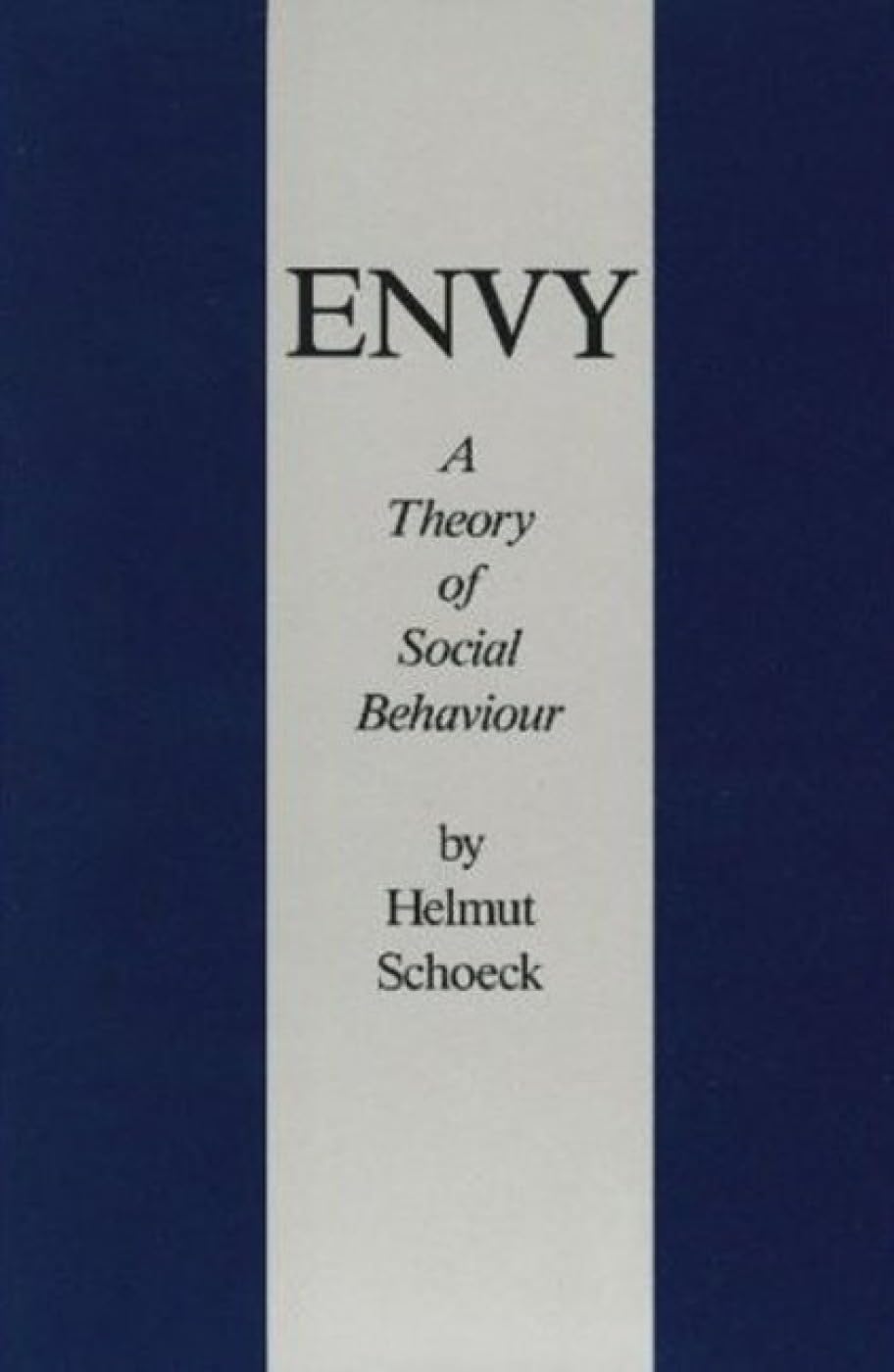
1. Envy: A Theory of Social Behaviour by Helmut Schoeck
The first book highlighted in the newsletter is Helmut Schoeck’s Envy: A Theory of Social Behaviour, a work described as part sociological theory and part political tirade. Schoeck’s analysis posits that envy is fundamentally caustic and that all functional societies must learn to suppress it to some degree. According to the author, envy discourages individual effort and achievement, thereby holding back not only productivity and wealth generation, but even ordinary virtues, as individuals seek to avoid attracting the malicious "evil eye" of their neighbors.
Schoeck also challenges traditional political notions of envy, arguing that the emotion does not function the way class-conscious political organizers might hope. Humans are shown to be far more envious of small differences among their close associates than they are of massive wealth gaps separating them from people far away. As an historical illustration, Young points to the Cultural Revolution in China, where the brunt of local malice was borne not by distant ruling elites, but by schoolteachers, small landowners, and others who were only slightly better off than their peers in local villages. Although Schoeck’s targets are primarily left-wing politics, Young notes that it is difficult not to see similar sentiments embedded within the right-wing populism sweeping the world today. Ultimately, despite cultural assumptions that society has matured enough to debate the trade-offs between growth and equality, Envy serves as a potent reminder that humanity remains, in many ways, a society of children upset that a neighbor has a slightly nicer toy.
2. Infinite Powers by Steven Strogatz
Shifting from human behavior to the foundations of exact science, Steven Strogatz’s Infinite Powers offers a comprehensive look at the history of calculus, one of mathematics’ crowning achievements. Young, who has previously expressed admiration for Strogatz’s work—particularly his educational material on chaos theory—praises the book’s historical scope.
However, Young offers one minor critique regarding the book’s presentation. Strogatz appears almost to bend over backward to convince the reader of calculus’s importance, a tactic that feels as though a pushy editor intervened with instructions to amplify practical examples for maximum general interest. Young suggests that anyone whose eyes would naturally glaze over at the thought of advanced mathematics is unlikely to pick up a book on calculus in the first place, rendering these strenuous efforts to hype the subject somewhat unnecessary.
3. The Fragility of Goodness by Martha Nussbaum
In the realm of philosophy, Martha Nussbaum’s The Fragility of Goodness addresses the painful reality that life is precarious and that human beings frequently fail to do the right thing or secure what they desire. Going beyond this familiar observation, Nussbaum asks whether there are situations in life where doing the right thing is mathematically or morally impossible—moments when individuals are left with no good options and all choices involve sacrificing a dearly held value.
Nussbaum argues that such tragic binds do exist, and that ancient Greek tragedians recognized them as an intrinsic part of the human condition. Their works are genuine tragedies not simply because bad things happen to good people, but because individuals are forced into positions where they have no choice but to act badly—caught in a cycle of being damned if they do and damned if they don’t. Young notes that philosophers since Plato have attempted to reorganize the human interior life to render such tragedies impossible, seeking clear and consistent orderings of human values so that a correct decision always exists. From Socrates’ intellectual pull away from the perceptible world into pure ideas to Jeremy Bentham’s utilitarian calculus measuring all human values with a single ruler, these philosophical projects consistently seek to rid existence of the painful possibility that many life problems possess no good answer.
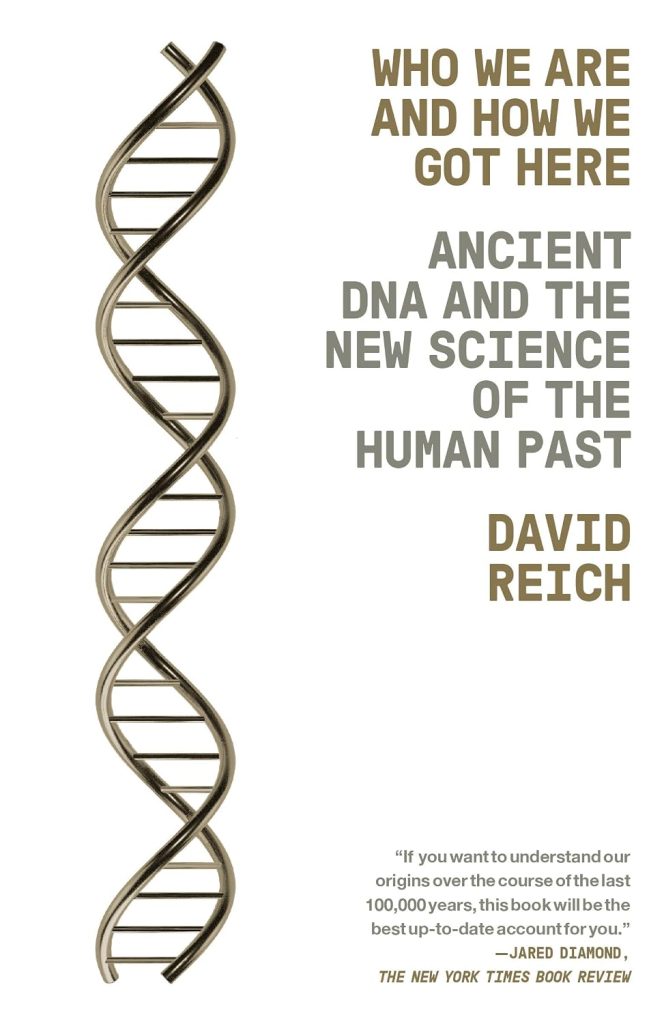
4. Who We Are and How We Got Here by David Reich
Turning to the deep history of human ancestry, David Reich’s Who We Are and How We Got Here examines how recent breakthroughs in genetic science have transformed historical understanding. Modern geneticists are now able to extract DNA sequences from the skeletons of ancient humans, sequencing that material and comparing it against other archaeological specimens and living populations to construct an unprecedentedly rich picture of human lineage.
There is a common cultural tendency to view our current cosmopolitan age as an historical aberration—an assumption that, until recently, populations lived largely where they settled after initial migrations out of Africa. Under this view, the notion that Chinese people are from China, Europeans from Europe, and Indigenous peoples in the Americas settled roughly where they landed after crossing the Bering Strait tens of thousands of years ago makes multi-ethnic societies seem highly unusual. However, Reich’s research demonstrates that the human past was far more dynamic and interconnected than commonly realized, characterized by frequent population mixtures, mass migrations, continent-scale conquests, and repeated returns, all recorded within human genomes despite the absence of written records.
5. The Myth of Sisyphus by Albert Camus
In Albert Camus’s classic work The Myth of Sisyphus, the author famously declares that there is only one truly serious philosophical problem, which is suicide. To Camus, human life is inherently absurd and meaningless, leaving the central question of whether such an existence is still worth living.
Camus answers in the affirmative, using the metaphor of creating art that fundamentally does not matter. He advocates for a form of experiential gluttony—maximizing one’s experiences and treating the act of living itself as a form of rebellion against an uncaring cosmos. Regarding Sisyphus, the mythological figure condemned by the gods to spend eternity pushing a boulder up a hill only to watch it roll back down, Camus argues that the laborer need not be suffering. Instead, Sisyphus possesses a clear understanding of his plight, and from that absolute understanding comes true freedom.
Young offers a nuanced critique of Camus’s conclusion, noting that while the philosophy is provocative, its solution feels psychologically implausible. Young suggests that human beings are deeply teleological, goal-directed creatures for whom living without purpose is anathema, and that what requires reform is not innate human psychology, but rather a conception of meaning capable of accommodating a universe that does not provide pre-existing, eternal purposes.
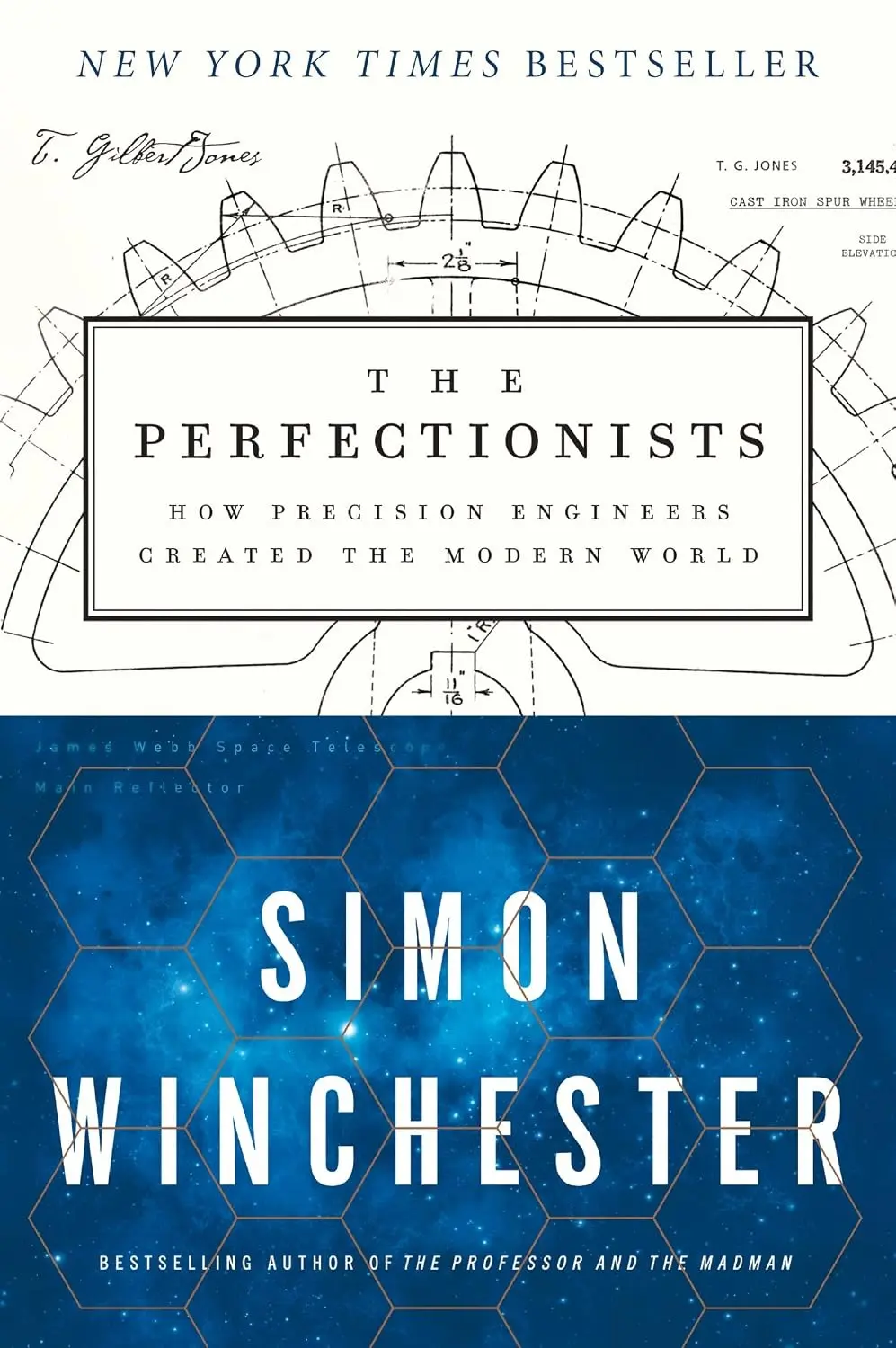
6. The Perfectionists by Simon Winchester
Simon Winchester’s The Perfectionists explores the foundational concept upon which the modern world is constructed: precision. By manufacturing goods with ever-increasing exactness, humanity has solved technological puzzles that ancient civilizations could only imagine. Winchester guides readers through a historical tour beginning with early precision-machined cannons—milled to within the width of a coin—and culminating in the photolithographic processes used today to manufacture advanced computer chips with precision measured to within a few atoms.
Among the book’s highlights is a comparison between Rolls-Royce and Ford automobiles. While Rolls-Royce earned renown for exquisite hand craftsmanship, it was Henry Ford’s Model T that achieved a higher degree of true precision. The rationale was operational: Ford needed to mass-produce vehicles utilizing identical, interchangeable components. Because workers were unable to manually file and fit pieces until they lined up perfectly, every individual component had to be manufactured to a standard of perfection far exceeding that of any single part in a hand-crafted luxury automobile.
7. The Marginal Revolution by Tyler Cowen
Tyler Cowen’s The Marginal Revolution offers a historical examination of marginalism—the economic theory dictating that decisions should be analyzed not by looking at average costs, but by determining the cost or utility of doing one incremental unit more of something. Cowen illustrates the concept using the famous diamond-water paradox, which questions why water, essential for life, is cheap, while diamonds, which are largely ornamental, are exceptionally expensive.
Marginalism resolves this paradox by explaining that the price of a resource is determined not by its total value to an individual, but by its marginal value—the worth of one additional unit. Because water is abundant, the marginal value of an extra glass is relatively low compared to its vast supply. Cowen argues that while marginal thinking has generated enormous productivity for economic science, its central place within the discipline is declining. Price theory, which places marginalist principles at the forefront, has increasingly lost ground to econometrics and other sophisticated mathematical modeling techniques, suggesting that marginalist thinking may be declining on the margin.
8. Catch-22 by Joseph Heller
Concluding the newsletter is Joseph Heller’s Catch-22, identified by Young as potentially the funniest book he has ever read. A blistering satire on war, military bureaucracy, and the inherent paradoxes of human existence, the novel derives its title from a fictitious bureaucratic rule governing bomber pilots seeking to escape combat missions.
The rule dictates that a concern for one’s own safety in the face of real and immediate danger is the product of a rational mind, meaning a pilot like Orr was technically crazy and could be grounded simply by asking. However, the moment he asked to be grounded, he would instantly demonstrate a rational concern for his safety, thereby rendering himself legally sane and obligated to continue flying combat missions.
Sprinkled with numerous other observations regarding the absurdities of life, bureaucracy, and human behavior, Heller’s classic novel serves as a potent reminder for Young that fiction remains essential—not merely for entertainment, but for the rigorous, unconventional thinking it continually stimulates.