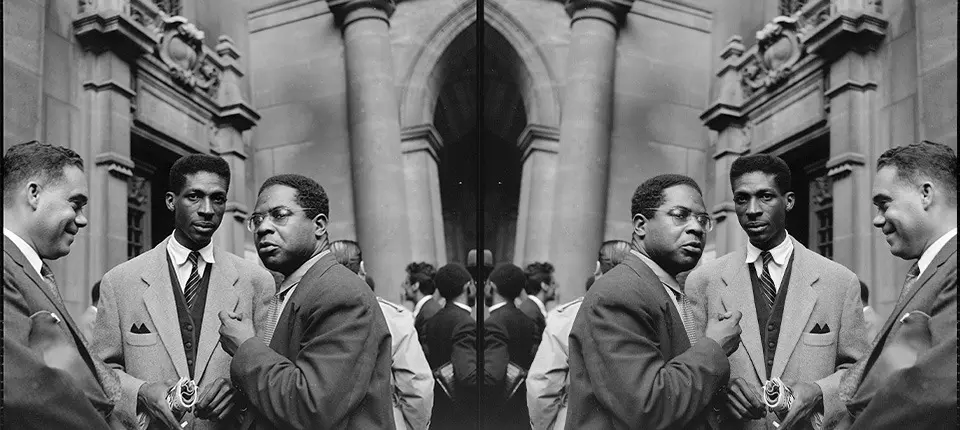
Historical Milestones: The First International Congress of Black Writers and Artists
This week in literary history marks a monumental anniversary. In 1956, the First International Congress of Black Writers and Artists convened at the Sorbonne in Paris. Organized by the pioneering publishing house Présence africaine, the gathering served as a vital intellectual crossroads for the global Black diaspora.
The Congress brought together some of the most formidable intellects and literary artists of the twentieth century to debate art, politics, colonialism, and identity. Among the distinguished speakers were Richard Wright, Léopold Senghor, Aimé Césaire, and Frantz Fanon. Their discussions at the Sorbonne helped lay the theoretical and cultural groundwork for decolonization movements across Africa and the Caribbean, while profoundly reshaping global literature and post-colonial discourse.
Moving from the foundational debates of Paris to the broader rhythms of the literary calendar, this week’s digital landscape also highlights John Keats. In this week in literary history, the Romantic poet famously sat down to write "To Autumn," capturing the melancholy and sublime transition of the changing season—a timeless meditation that continues to resonate with readers and writers alike.
Community, Craft, and the Business of Books
The contemporary literary internet is heavily engaged in exploring the physical and institutional realities of how books are made, sold, and discussed. For aspiring entrepreneurs and literature lovers alike, the question of community infrastructure remains paramount. One recent reflection tackles the grassroots effort of bookstore creation, examining how opening an independent book store can spark a renewed sense of local community and even inspire entirely new works of fiction.
On the other side of the creative spectrum, writers continue to grapple with the ethical and emotional dimensions of storytelling. Discussions this week explore the delicate boundary of writing real and imagined lives, particularly examining narratives both inside and outside of prison systems. This theme of confinement and institutional reality extends to broader political and social critiques, including an examination of how white supremacist literature circulates and establishes itself within prison environments, contrasting sharply with how incarcerated writers use poetry to reclaim their narratives. For instance, writer Abdelrahman ElGendy recently explored the Egyptian prison poem that ultimately came to structure his own memoir.
Meanwhile, questions of craft and institutional spaces persist. A recurring debate asks who actually benefits from the traditional Master of Fine Arts (MFA) workshop model, probing whether these academic hothouses truly serve emerging writers or merely reinforce existing literary hierarchies. At the same time, authors continue to reflect on the external pressures of the modern digital landscape. Essays this week investigate the detrimental nature of convenience culture in the digital age, drawing a sharp line between modern technological shortcuts and the deliberate, often inconvenient labor required to write a book. In a parallel piece, writers revisit Vikram Chandra’s classic ode to the art of human coding, considering what it means to preserve human creativity and labor in an increasingly automated age dominated by artificial intelligence.
Humor in Tumultuous Times and Personal Identity
Navigating the complexities of the modern world requires resilience, and several prominent authors this week have addressed how art responds to crisis. Acclaimed author Rabih Alameddine recently offered insights on writing humor in times of tumult and tragedy, discussing how comedy can serve not as a dismissal of suffering, but as a vital survival mechanism and a lens for examining human absurdity.
Identity, displacement, and belonging also form a major thread in recent essays. Writers are exploring what it means to come to terms with modern Russia, examining the emotional weight of falling out of love with a country shaped by historical and political shifts. Closer to home, essays delve into the intricate terrain of family and identity, particularly focusing on the experiences of Korean adoptees trying to look into the mirror of their past within the United States.
The physical and emotional self remains a central preoccupation for poets and prose writers alike. Critics have highlighted powerful new works centered on the body, including five essential books exploring the body as embodied, unbodied, and destroyed. In poetry, heartbreak continues to find profound expression, with critics rounding up nine distinct collections of poetry focused specifically on breakups and awakenings.
Cultural Criticism, Film, and Screen Adaptations
The intersection of literature, film, and television continues to generate robust discussion. With the fall season underway, critics and readers are navigating the most anticipated mysteries, thrillers, and crime novels hitting shelves, alongside an extensive catalog of literary film and TV shows making their way to streaming platforms.
Cultural criticism this week also takes aim at cinematic tropes and historical legacies. One essay closely analyzes the orientalism and imperial gaze evident in Western horror films, using Lee Cronin’s The Mummy as a case study for how Hollywood frames the exoticized "other." In memory and biography, tributes have poured in for iconic figures. Writers have reflected on the legacy of Robert Redford, celebrating his dual life as a major movie star and a pioneering conservationist through the origin story of the Sundance Institute. Another retrospective honors Anna May Wong, remembering her trials and triumphs as Hollywood’s first Asian-American star.
Women’s voices and social dynamics are likewise at the forefront of contemporary commentary. Anna Holmes recently penned an insightful essay on the enduring power of saying "no" as a woman in the modern world, examining the boundaries required to navigate professional and personal spaces. In the realm of contemporary fiction and publishing, writers are examining the unexpected ways everyday gaps are filled—such as how romance novels have historically stepped in to provide education when traditional sex education proves insufficient.
Global Voices and New Releases
International literature and translation continue to anchor much of the literary conversation. Translators are shedding light on the painstaking work required to bring global stories to English-speaking audiences, such as Antonella Lettieri discussing the translation of Roberta Recchia’s debut novel, All That Is Left of Life.
Meanwhile, master storytellers continue to share their processes. Readers have been treated to a rare look at how legendary author Isabel Allende transformed a personal letter written to her grandfather into a fully realized novel, finding the ultimate freedom to write through vulnerability. Children’s literature is also receiving its due, highlighted by an in-depth interview with Jon Klassen, the celebrated creator recently named the winner of the 2026 Astrid Lindgren Memorial Award, discussing the unique artistic space of the board book.
As the literary community transitions further into the autumn publishing season, platforms like Book Marks continue to aggregate the best-reviewed books of the week, offering readers a reliable compass for navigating the sheer volume of new releases. Whether through deep dives into bookshelf organization—such as how Madeleine Thien arranges her personal library—or critical assessments of emerging fiction, the literary internet remains a vibrant ecosystem dedicated to the enduring power of the written word.